
Q2’2026 Update: Consumer Sentiment Softens Despite Economic Growth

Welcome to Malaysians on Malaysia (MOM): Oppotus’ quarterly report that provides in-depth insights into the Malaysian Consumer Confidence Index (MYCI). It is an ongoing effort to offer insights into Malaysia’s evolving market landscape. This edition delves deeper into the latest consumer trends and key influencing factors, including financial outlook, economic confidence, digital payments, tech trends and more, offering a fresh perspective for strategic decision-making. Join us as we explore the driving forces behind this quarter and the potential implications.
Malaysian consumers’ confidence took a concerning dip in the second quarter, weighed down by several major events — chief among them escalating geopolitical tensions and headline inflation rising from 1.9% to 2.0% in May. According to DOSM, the food & beverages and housing, water, electricity, gas & other fuels groups were among those affected, each rising between 0.1% and 0.2%. Before diving deeper into this chapter, readers are encouraged to revisit the Q1 2026 MOM report.
Malaysians’ Confidence Shaken
Q1 2026 started on a strong note, but confidence took a hit in Q2, falling from 135 points to 123 points. The spillover of geopolitical tensions, which lingered well into the quarter — weighed heavily on sentiments, straining the petroleum sector across many countries, including Malaysia. In response, the government temporarily adjusted the BUDI95 fuel quota from 300 litres to 200 litres per individual, effective April.
Sharp Dip in Economic Sentiment
This quarter’s economic sentiment also followed a concerning trend, dipping sharply by 12% from Q1 2026 to land at 116 points. This came despite the government’s efforts to cushion global tensions — continuing the BUDI95 fuel subsidy while welcoming renewed foreign direct investment (FDI) inflows and structural economic reforms, which helped the Ringgit strengthen against the US dollar.
E-Wallets and Cash Hold Steady
For a few quarters now, e-wallets have marked their territory as the norm for Malaysians’ payment method. This is reflected in the usage share of physical transactions, where digital payments (in any form) have held a steady 80% against cash’s 20% for three consecutive quarters. Within that digital payments breakdown, e-wallets remain the largest contributor at 22%.
If you are eager to dive deeper into these numbers and gain a more nuanced understanding of the forces shaping the future of business and finances, reach out to us at theteam@oppotus.com. You can also hop onto our alternative service, Oppotus DoubleDecker, an Omnibus solution to gain a first-hand preview of our next MOM report.
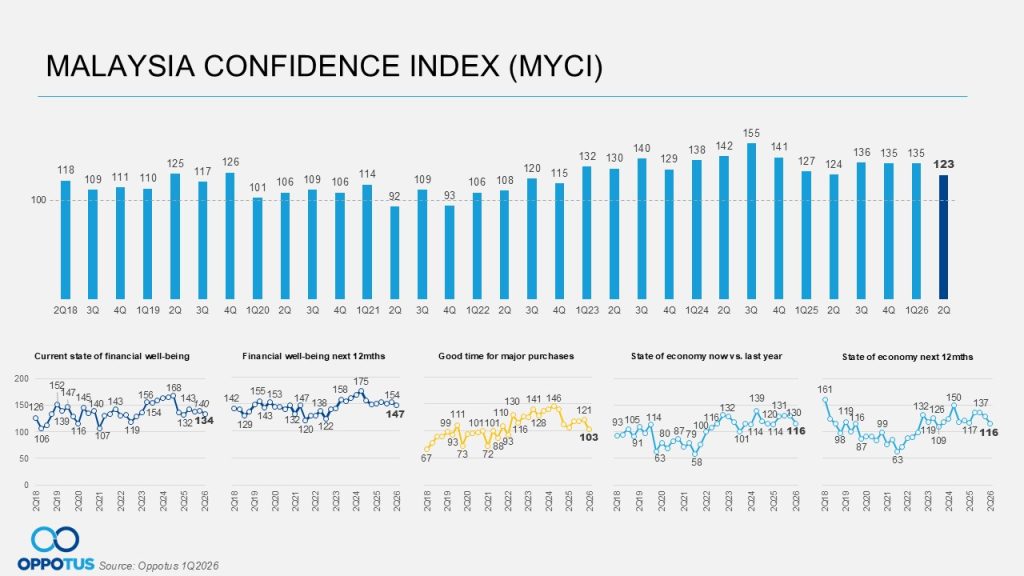
Q2 2026 sees a 10% dip in Malaysian consumers’ confidence, resulting in a 123 points drop. Based on year-to-year comparisons, it also fell by a 1-point mark, as Q2 2025 landed at 124 points. This reverses the stability of the first quarter and reflects the toll of prolonged geopolitical tension and rising living costs. The dip is felt across nearly every MYCI component.
During this period, many shipment especially oil tankers and commercial ships, was impacted due to the closure of the Strait of Hormuz, resulting in a significant reduction in global crude oil supply and a sharp rise in oil prices. Fuel security also became a live concern, with Petronas reassuring the public that domestic supply remained sufficient through end-July, even as the government held the BUDI95 quota at 200 litres per individual per month, a level set back in April.
It also added to the cost of living pressure as the headline inflation climbed to 2.0% in May — its highest level in nearly two years — before easing slightly to 1.9% in June, according to DOSM. Food & beverages, housing & utilities, and information & communication were the main groups pushing prices higher, while transport inflation moderated on softer vehicle and logistics costs.
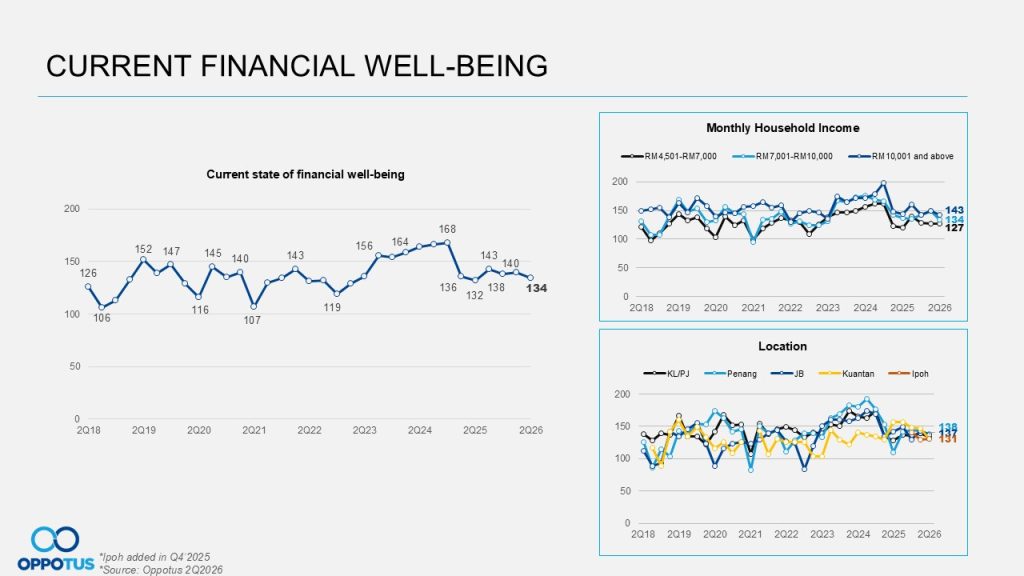
Moving into financial well-being, that also declined by 4% (Q2 2026; 134 points vs Q1 2026; 140 points). Such an impact is likely to be a spillover from the overspending in Q1 2026, as during the period, there were multiple long holidays due to Raya and the Chinese New Year season.
The consumer price index (CPI) increased to 137.1 from 134.4 a year earlier. In May, there were four consumer groups registered with higher inflation, led by information and communication, which rose 2.1% compared with 2.0% in April. Food and beverages inflation also edged up to 1.4% from 1.2%, while housing, water, electricity, gas and other fuels increased by 1.2% from 1.1%. While looking at core inflation, it remains flat at 2.0% compared to April and May 2026.
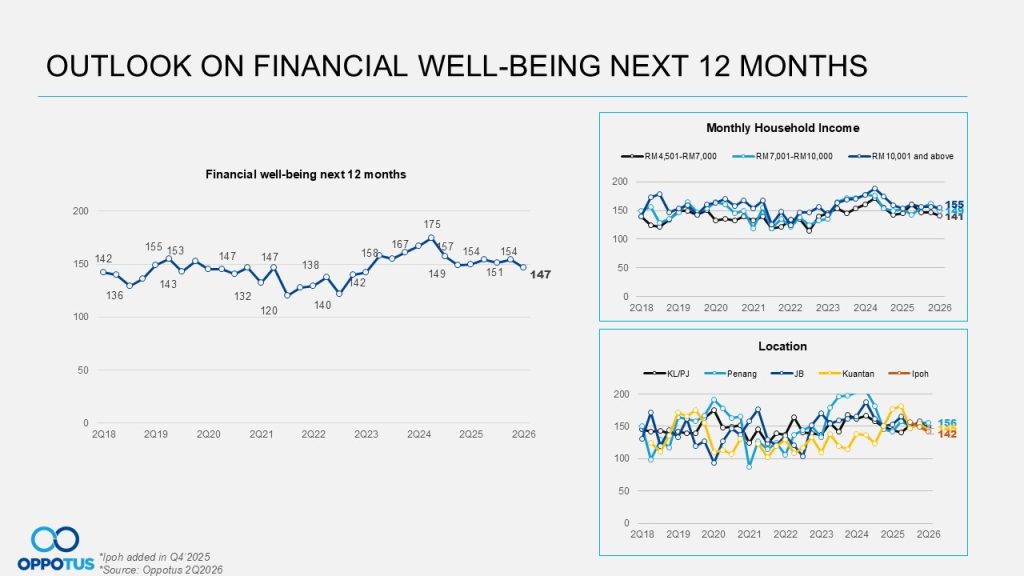
Looking ahead, the optimism about financial well-being over the next 12 months has dropped from 154 points in Q1 2026 to 147 points in Q2 2026. This result is still within the average of 151 points since Q4 2024 till now. The average point is a reminder that households are becoming more cautious about the road ahead.
On the labour front, Malaysia’s unemployment rate edged up to 3.0% in May 2026 (513,400 people), from 2.9% in the first quarter — its highest reading since October 2025, even as DOSM described the broader labour market as still moderately improving. The labour force participation rate held steady at 70.9%, and youth unemployment (ages 15–24) stayed flat at 10.2%
That said, the public sector, statutory bodies and government-linked companies (GLCs) will work-from-home (WFH) starting 15 April as the government moves early to cushion the impact of the global energy crisis. As the global situation is expected to worsen before it improves, the recovery period will be prolonged.
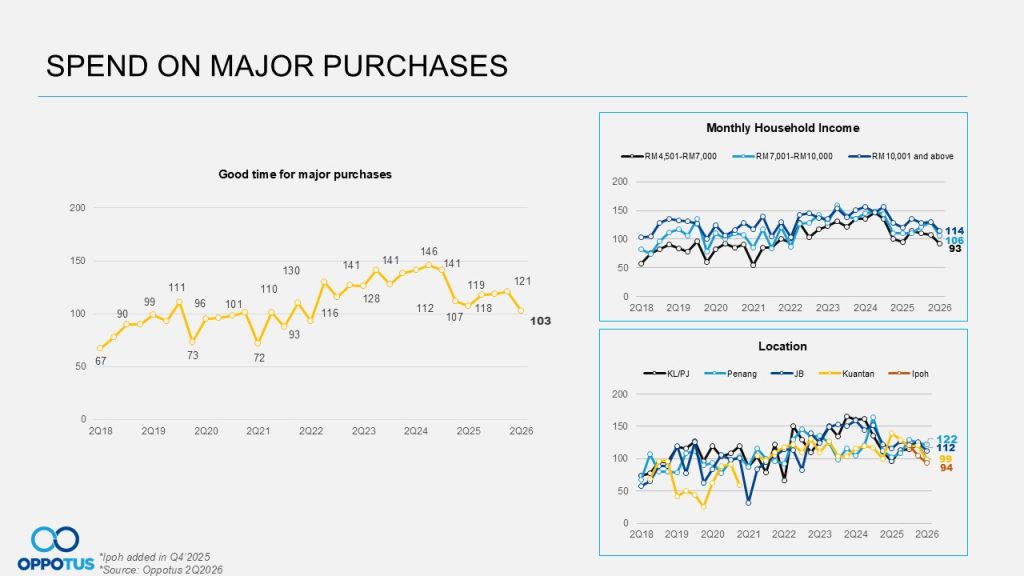
Sentiment toward major purchases took the hardest hit of all the MYCI components, sliding to 103 points in Q2 2026 from 121 points in Q1 (15% drop), a clear signal that big-ticket spending intentions are being reined in as households absorb higher fuel and living costs.
Even though the major drop in this category, e-commerce platforms still worked hard to keep shoppers engaged. Shopee tied its ShopeePay Fiesta Bola campaign to the FIFA World Cup 2026, letting users vote on match outcomes for reward points and prizes running from June through July. TikTok Shop launched its 6.6 Birthday Mega Sales from 3 – 8 June, featuring up to 70% off “Jimat Gila” deals, upsized unlimited free shipping, and special live voucher offerings up to 66% off across beauty, wellness, and lifestyle categories. It also partnered with KPDN to offer reduced commission fees and discounted shipping on essential goods — part of a broader push to ease cost-of-living pressures for sellers and shoppers alike.
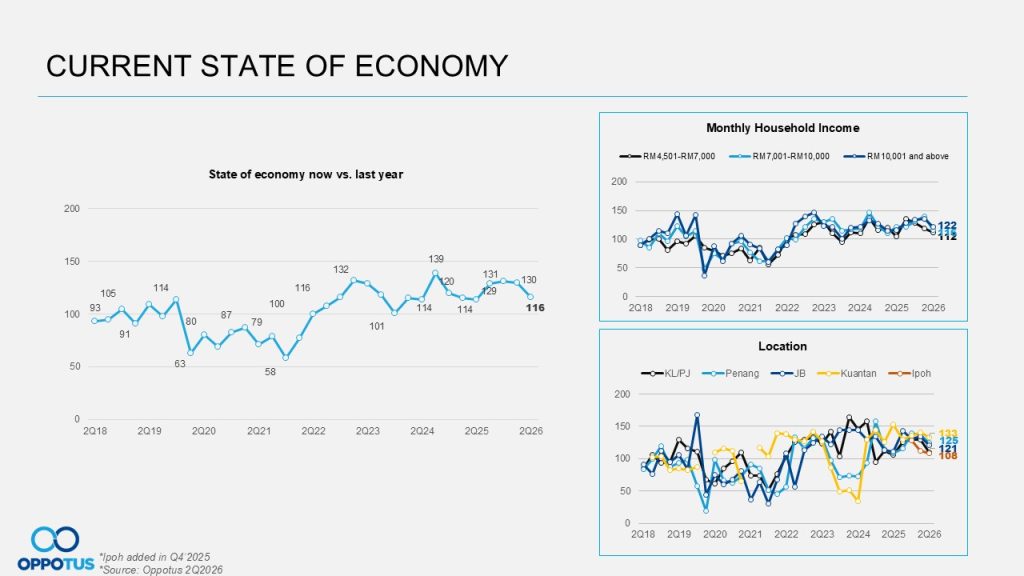
Interestingly, the current state of the economy tells a more divergent story. Sentiment fell to 116 points in Q2 2026 from 130 points in Q1, yet the real economy actually accelerated — advance estimates from DOSM show GDP growth quickening to 5.8% year-on-year in Q2, up from 5.4% in Q1, lifting first-half growth to 5.6%. The gap between hard data and how Malaysians feel about the economy is itself telling: growth was driven by a strong rebound in manufacturing (7.5%) and mining, sectors that don’t always translate into a household-level sense of financial ease, especially against a backdrop of rising prices and global uncertainty.
Tourism remained a bright spot. Malaysia welcomed 17.5 million international visitors between January and May 2026, up 3.4% year-on-year, keeping the Visit Malaysia 2026 (VM2026) campaign on track toward its 47 million target. It is building on a record-breaking first quarter that had already logged 10.65 million arrivals.
Even so, the government’s own advisers flagged the fragility beneath the surface. In May, a Prime Minister’s Office adviser warned that Malaysia could face a supply crunch by July that money alone could not fix, underscoring how exposed the country remains to the ongoing Strait of Hormuz tensions and broader Middle East conflict — even as GDP figures continue to impress.
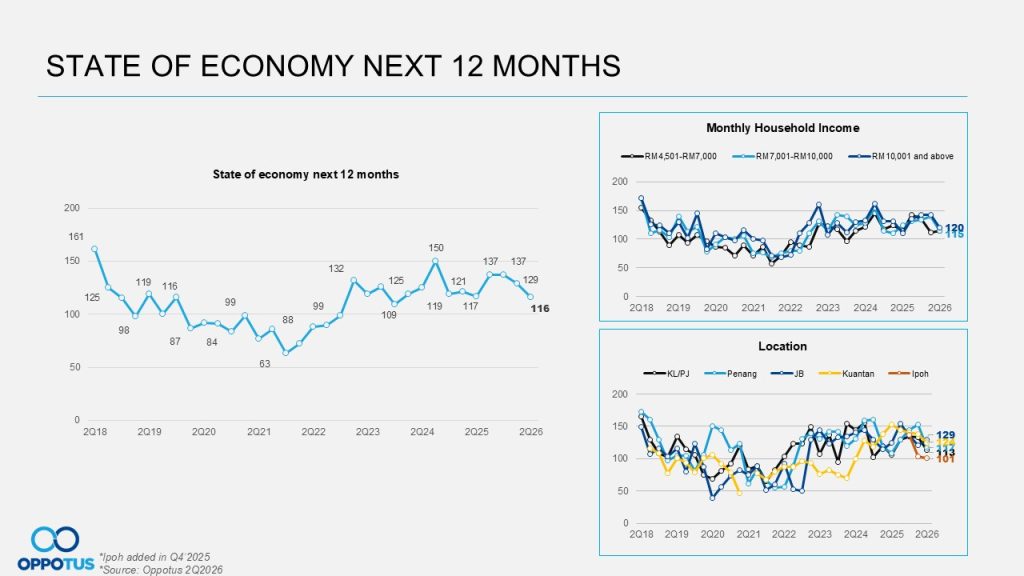
Looking further out, Malaysians’ confidence in the economy’s next-12-month trajectory also slipped, easing to 116 points in Q2 2026 from 129 points in Q1 — mirroring the dip in the current-state reading and suggesting households expect this quarter’s pressures to persist rather than pass.
Rising costs remain the common thread behind the pullback. DOSM’s official data shows headline inflation reaching a near two-year high of 2.0% in May before easing marginally to 1.9% in June, with information & communication, food & beverages, and housing & utilities the main contributors. Across income bands, sentiment softened in tandem, with even higher-income households typically the most resilient — reporting more caution about the year ahead.
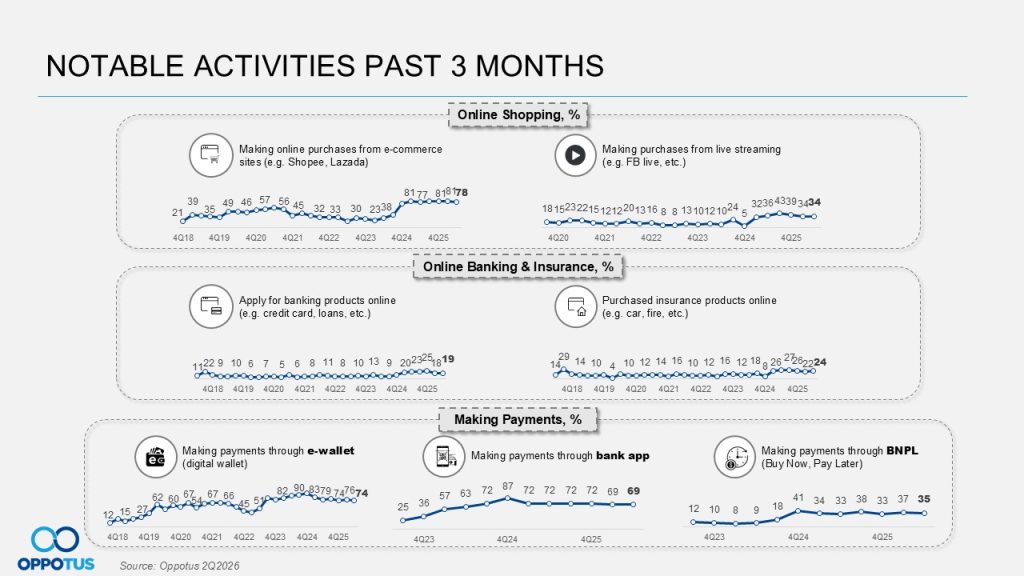
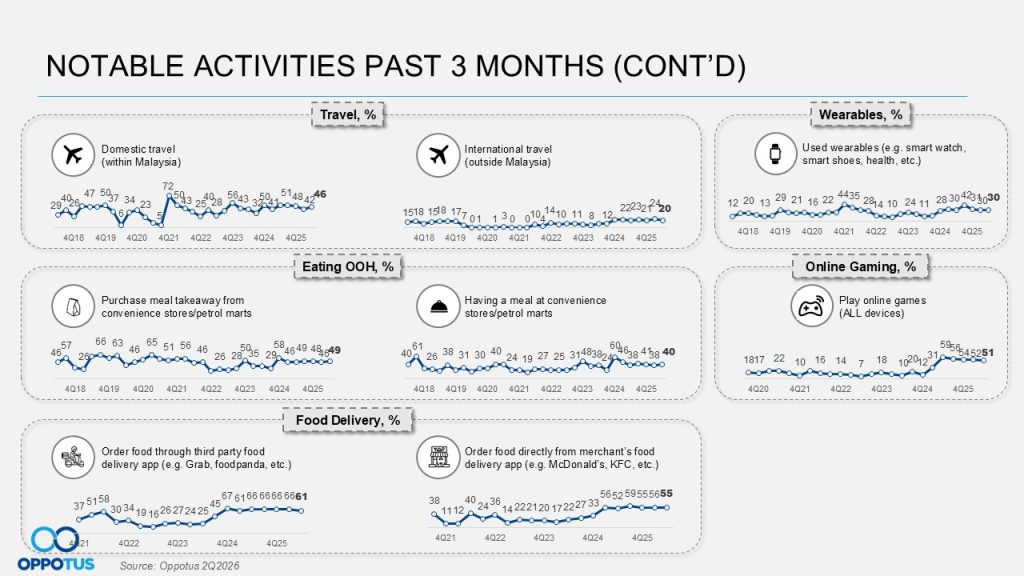
Consumer activity broadly cooled across the board this quarter. Online Shopping from e-commerce sites slightly dipped to 78% (from 81% in Q1), while purchases made through livestreams held flat at 34%. There were major campaigns tied to the World Cup and Mega-Sales throughout the quarter; shoppers were more measured with their spending. This is likely due to Q1 being a festive season, and it needed to be held back to the following quarter.
The slight increment in activities in the past 3 months: Domestic Travel (within Malaysia), which scored 46% as a 4% increase from the previous quarter. It is believed to be due to the multiple public holidays in May and June, creating a long weekend for most.
Food Delivery held within familiar ranges: ordering through third-party apps like Grab and Foodpanda came in at 61%, while ordering directly from a merchant’s own app remained flat at 55%, a touch above its recent 50% range. Eating Out-of-Home (OOH) had a slight uptick, with purchasing takeaway from convenience stores/petrol marts at 49%, and dining at convenience store/petrol marts climbed 2%, landing at 40% in this quarter.
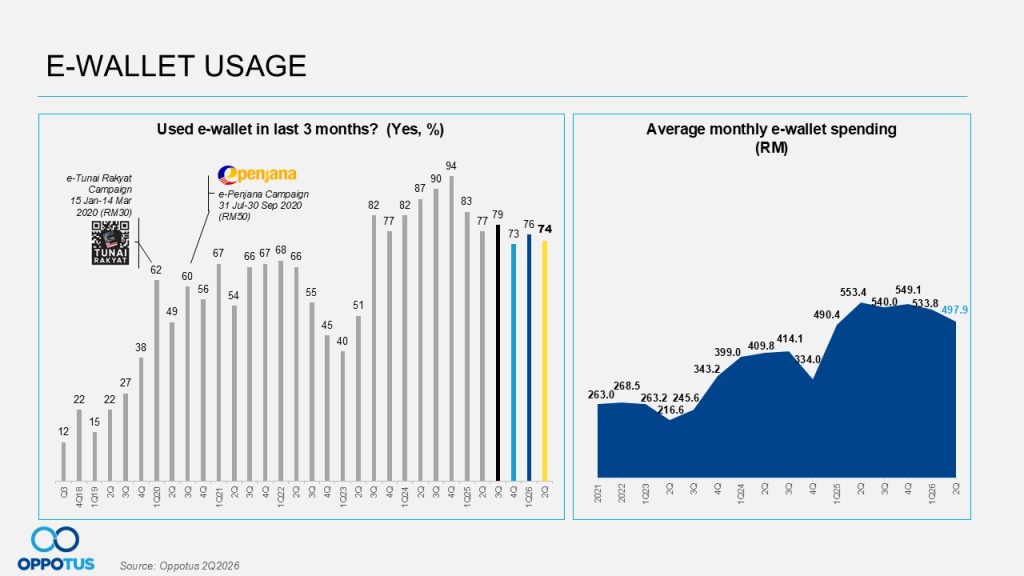
Turning to digital payments, a few quarters ago, e-wallets marked their territory as the norm for Malaysians’ payment method. Over the last 3 months, it eased slightly to 74% in Q2 2026. This is just a slight dip of 2.7% from the previous quarter. As noted, it is still sitting comfortably within the 70-80% band that it has held since Q1 2025. While the average monthly e-wallet spend also pulled back, falling below the RM500 mark for the first time since Q4 2024 to RM497.90, down from RM533.80 in Q1.
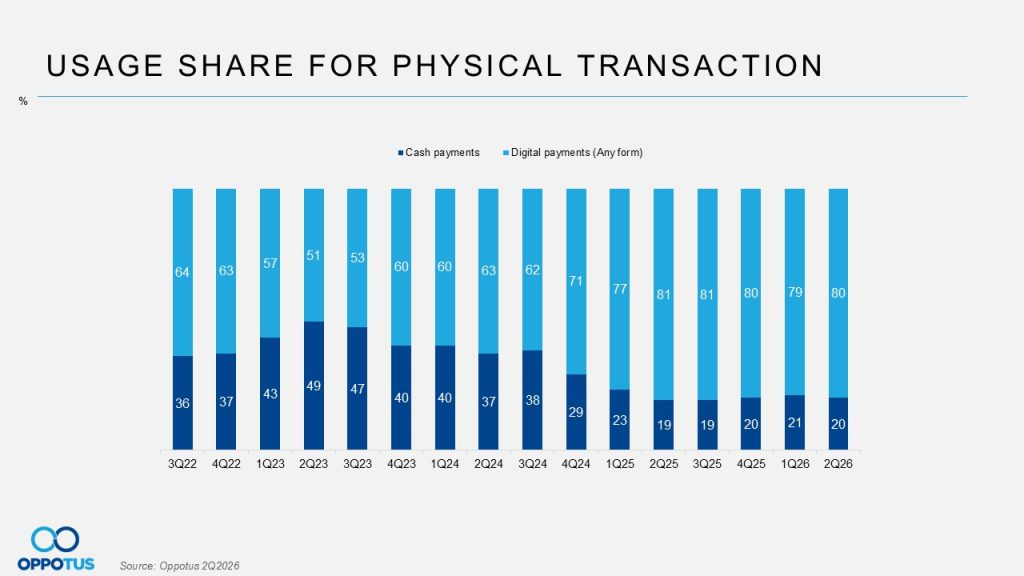
Zooming into the usage share for physical transactions, it is notable that it has begun to hover within 20% since the start of 2025 till now. The changes between quarters have been just a minor 1-2% adjustment, and it is expected to continue for the rest of the year due to its stability.
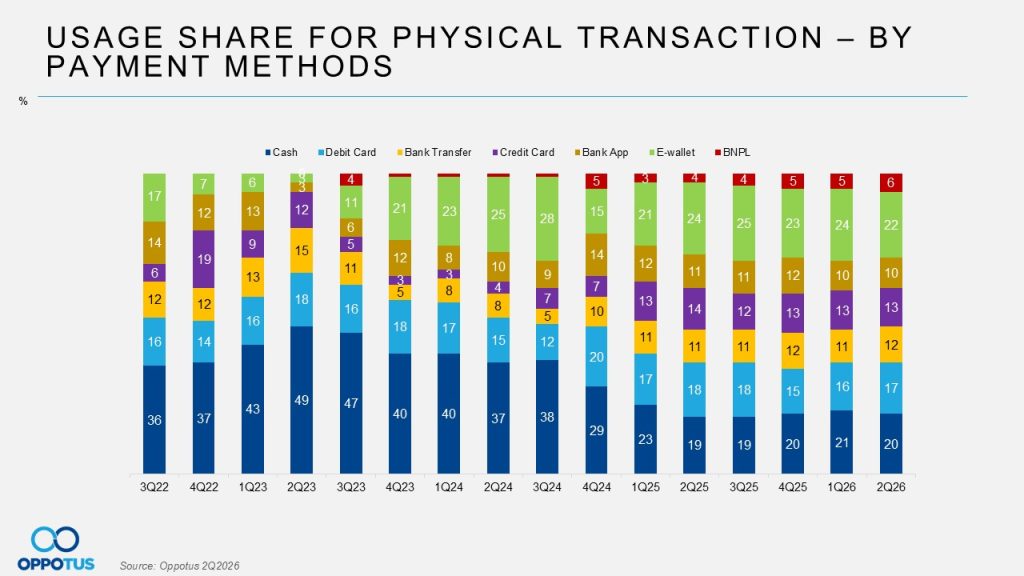
Moving into the breakdown of usage share for physical transactions by payment methods, at a glance, it has not had a significant change since Q2 2025. E-wallets remained on par or similar to cash within the 20% range, followed by debit cards.
BNPL is one of the notable payment methods, as it continues to grow by a small percentage each quarter. Resulting in 6% this quarter versus 5% in both Q4 2025 and Q1 2026. According to a financial expert, BNPL facilities are becoming increasingly common among middle-income borrowers, and it is no longer concentrated among low-income households. This is because they are struggling with high debt servicing commitments, leaving them financially vulnerable to unexpected financial shocks such as a medical emergency, which then leads them to lean on BNPL as an emergency fund.
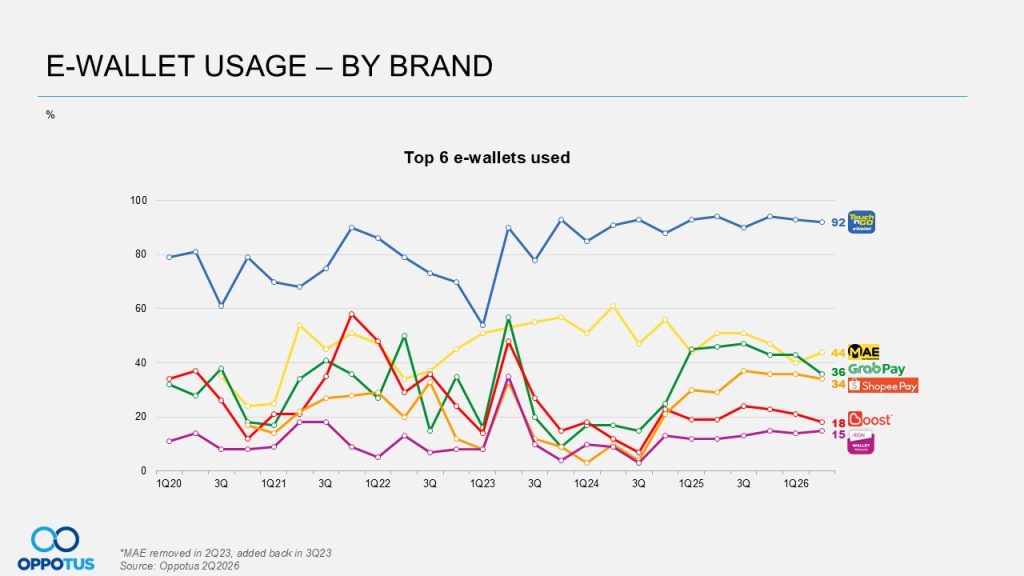
The e-wallet brand rankings saw a notable shake-up this quarter. Touch ‘n Go retained its firm grip on the top spot at 92% usage, largely unchanged from Q1’s 93%. The bigger story is MAE, which staged a sharp comeback — climbing to 44% usage and reclaiming second place from GrabPay, which slipped to 36%. ShopeePay held at 34%, while Boost (18%) and AEON Wallet (15%) rounded out the top six.
This marks a full reversal from Q1, when MAE had slipped to third place, 3% behind GrabPay. MAE rebounded this quarter with a jump of 4% more than the previous quarter.
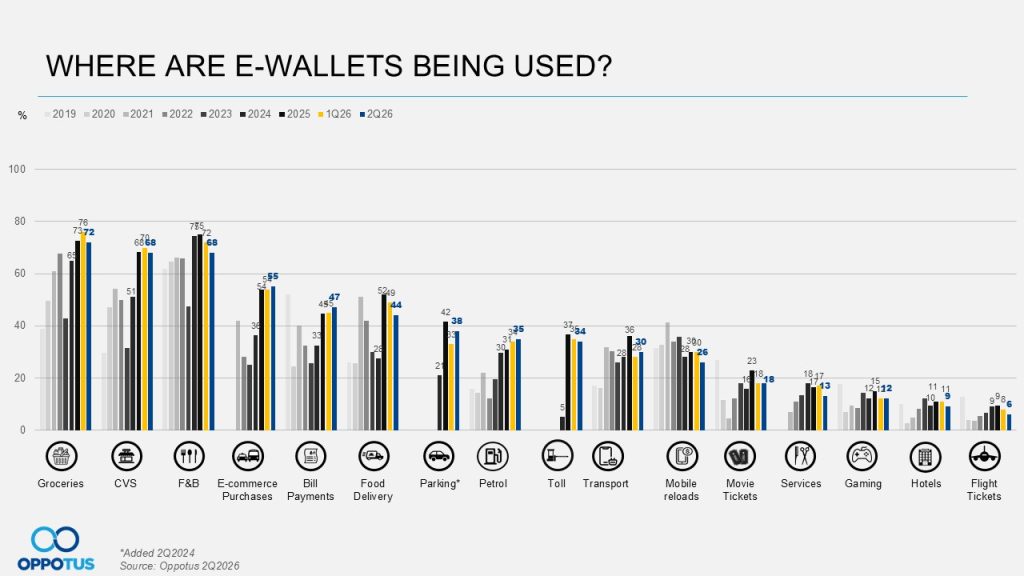
Zooming into the categories, Groceries kept its position as the most common e-wallet used at 72% (down from 76% in Q1), while CVS and F&B both eased to 68% apiece, effectively tying for second place after F&B’s sharper decline from 75% in Q1.
For the mid-tier, there is slight movement as Bill Payments climbed up to 5th (47%) from being 6th (45%) in Q1, Parking climbed to 8th place (38%) from 9th place, followed by Transport climbing to 10th (30%) from 11th place.
The smaller categories — Movie Tickets (18%), Services (13%), Gaming (12%), Hotels (9%) and Flight Tickets (6%) – all softened in line with the broader pullback in discretionary spending.
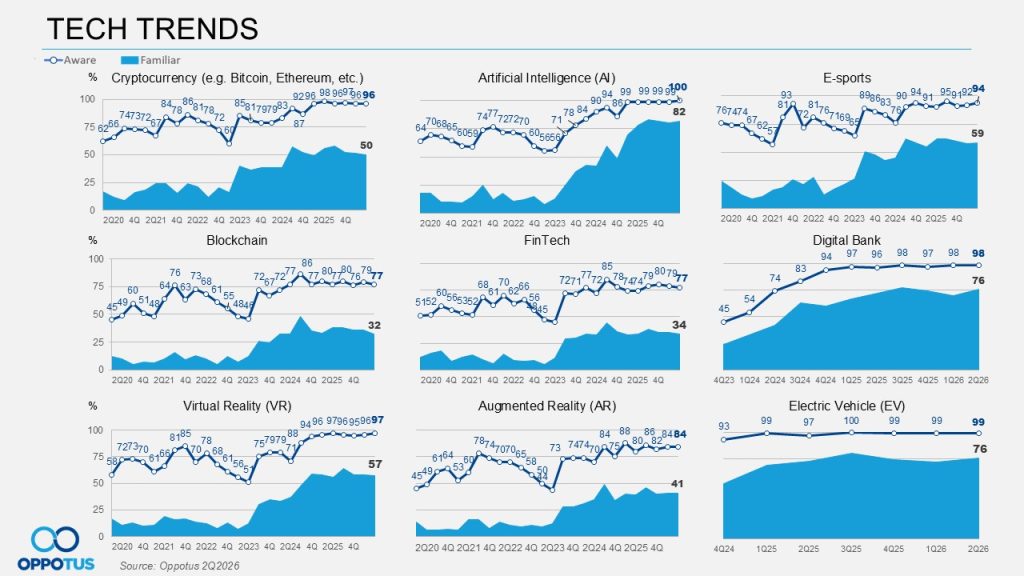
Switching to Tech Trends, Artificial Intelligence (AI) awareness reached a symbolic milestone this quarter, hitting 100% — with familiarity climbing to 82% from 80% in Q1. This continues to track the government’s push toward positioning Malaysia as an “AI nation” by 2030, anchored by its AI-standards framework covering standards development, regulation and compliance, and legislation and enforcement.
Aside from AI which sees an uptick this quarter, there are a few categories that also see a slight uptick, such as E-sports with an awareness of 94% and familiarity of 59%. It is likely that the upcoming E-sports World Cup, starting on 6 July and running through 23 August held in Paris, will be the first edition held outside of Saudi Arabia.
It is then followed by Digital Bank, with plateaued awareness of 98% and increased familiarity from 70% to 76% in Q2. There were multiple recognitions and initiative happened; RYT Bank surpassed 1.2 million users in the 7 months since its launch. It is one of the fastest-growing digital banks in Malaysia, and since then the bank has also processed more than 25 million transactions, with monthly volumes growing more than 35 times. While GX Bank has also crossed 1.4 million users after more than 2 years of operation as the Malaysian digital bank grows its retail and small business base.
Lastly, Electric Vehicle (EV) awareness also plateaued at 99%, but its familiarity had a 4% climb, resulting in 76%. This positive climb also resulted in ownership, as Proton e.MAS 5 has gained the crown of being number 1 in ownership at 1,309 units in June, followed by e.MAS 7 and Tesla Model Y and 3.
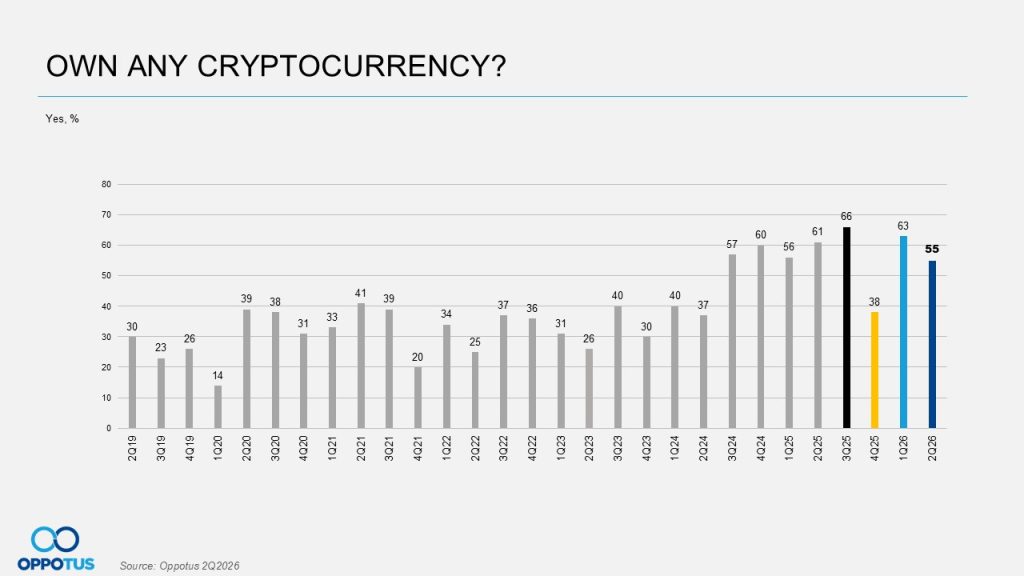
Cryptocurrency ownership, however, reversed its Q1 rebound. After stabilising around 63% in the first quarter, ownership fell back to 55% in Q2 2026 — an 8% drop that puts it back closer to its longer-run average, suggesting the earlier uptick may have been more sentiment-driven than structural.
The pullback comes even as global cryptocurrency markets have continued to see elevated volatility through the first half of 2026, with institutional interest remaining a live theme alongside heightened macro uncertainty — a dynamic that appears to be tempering, rather than derailing, local ownership trends.
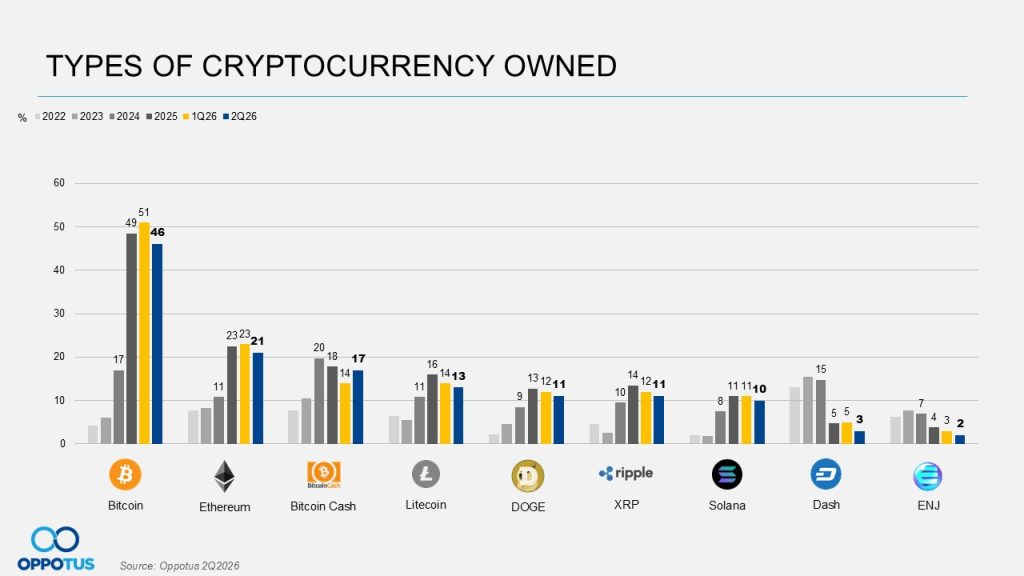
Ownership pulled back across the board on a like-for-like basis, aside from Bitcoin Cash, which is the only one that had a 21% increase from the previous quarter (Q1 14% vs Q2 17%).
Having said that, Bitcoin remains by far the most-owned cryptocurrency, though ownership eased to 46% in Q2 2026 from 51% in Q1. Ethereum ownership eased to 21% (from 23%). Litecoin, DOGE and XRP each hovered in the 11–13% range, with Solana at 10%, and Dash and ENJ rounding out the list at 3% and 2%, respectively.
Oppotus stays committed to acquiring insights through continual analysis, offering a unique perspective on the country’s trends and consumer landscape.
Note that the opinions presented regarding Malaysia and its people reflect the views of Malaysian citizens aged 18 and above, from all income segments, residing in key cities of the Peninsular, and selected in a representative manner.
For a more granular analysis of the data above, contact us at theteam@oppotus.com. Our team of experts would be pleased to facilitate a comprehensive review and offer customised recommendations tailored to your needs. Alternatively, explore the omnibus solution to incorporate additional measures for your business through our MOM study.