Adoption of AI in Malaysia 2026: How is it Going?

Artificial intelligence (AI) is no longer something Malaysians simply hear about – it is something they use, trust and intend to keep using. When we last took a close look at AI in Malaysia in May 2024, awareness had reached 84% and much of the conversation still centred on potential. Since then, the technology has moved from curiosity to routine, which leaves an obvious question: how is AI adoption in Malaysia really going?
Having tracked AI awareness and familiarity since 1Q 2020, we took a closer look at our latest data to see how Malaysians are using AI, why they are using it, and how they feel about what comes next.
How aware are Malaysians of AI?
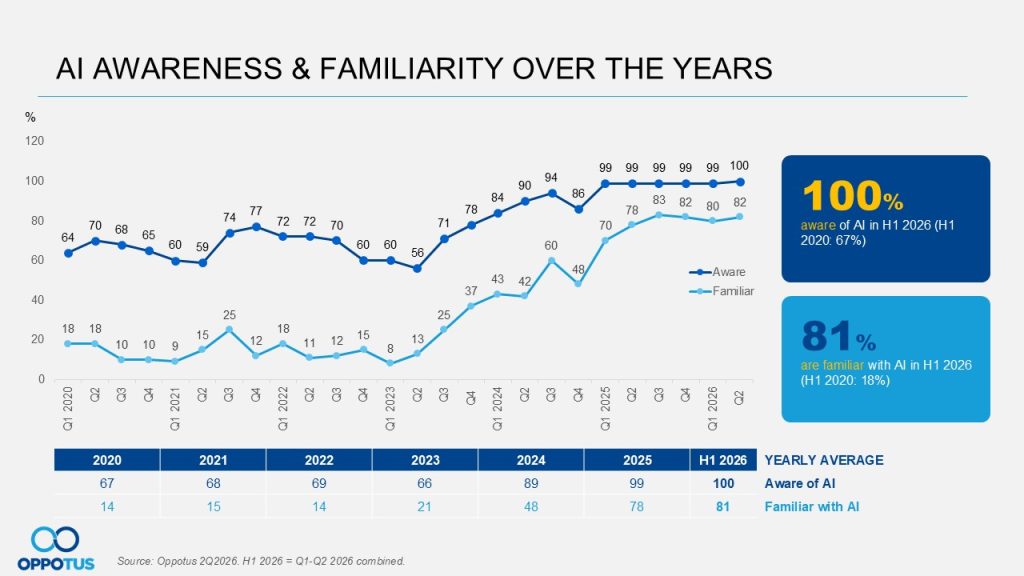
Looking at the long-term picture, AI awareness and familiarity were fairly flat during the early years of our tracking. Between 2020 and the first half of 2023, awareness moved within a range of 56% to 77%, while familiarity never rose above 25%. The turning point came in the second half of 2023, a period that coincides with the mainstream arrival of generative AI chatbots.
Familiarity climbed from 13% in Q2 2023 to 37% by Q4 2023, then averaged 48% in 2024 and 78% in 2025. Awareness, meanwhile, has effectively reached its ceiling, sitting at 99% in every quarter of 2025, and at 99% and 100% in Q1 and Q2 2026, respectively.
With awareness at its ceiling, familiarity is now the more meaningful measure, and here we see that four in five respondents (81% in H1 2026) say they are familiar with AI, compared with an average of just 14% in 2020. This is in line with Malaysia’s National AI Action Plan 2026-2030 (AI Nation 2030 agenda), to shape Malaysia’s long-term AI direction by developing talent, AI literacy, ecosystem capabilities and national readiness for future national planning and strategic foresight.
Which AI tools do Malaysians use most?
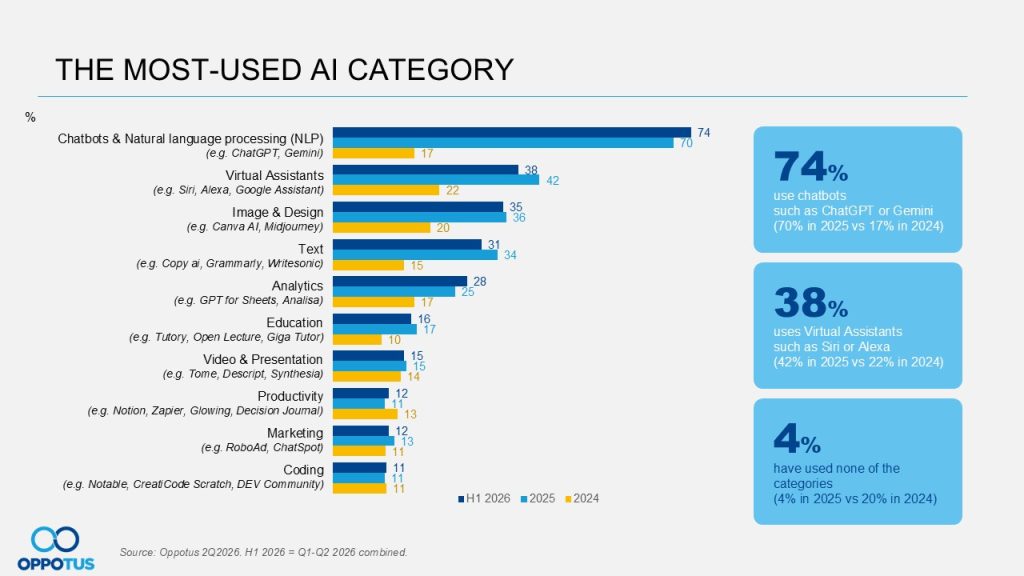
This familiarity is translating into usage across a wide range of AI applications. Chatbots and natural language processing (NLP) tools such as ChatGPT and Gemini are by far the most-used category, with 74% of respondents having used them. This category also saw the biggest jump of all: from just 17% in 2024 to 70% in 2025, more than quadrupling. The rise is likely due to the accessibility of chatbots and the social media trend of generating AI images.
Virtual assistants such as Siri and Alexa come next at 38%, followed by image and design tools such as Canva and Midjourney (35%), text tools such as Copy.ai and Grammarly (31%) and analytics tools (28%). The remaining categories – education, video and presentation, productivity, marketing and coding – each sit between 11% and 16%. Only 4% have yet to use any of these categories, compared with 20% in 2024.
It is also interesting to note that between 2025 and H1 2026, usage of virtual assistants eased from 42% to 38% and text tools softened slightly, while chatbots continued to grow. This may suggest that general-purpose chatbots are increasingly covering tasks that once required separate tools.
How many Malaysians use AI, and for what?
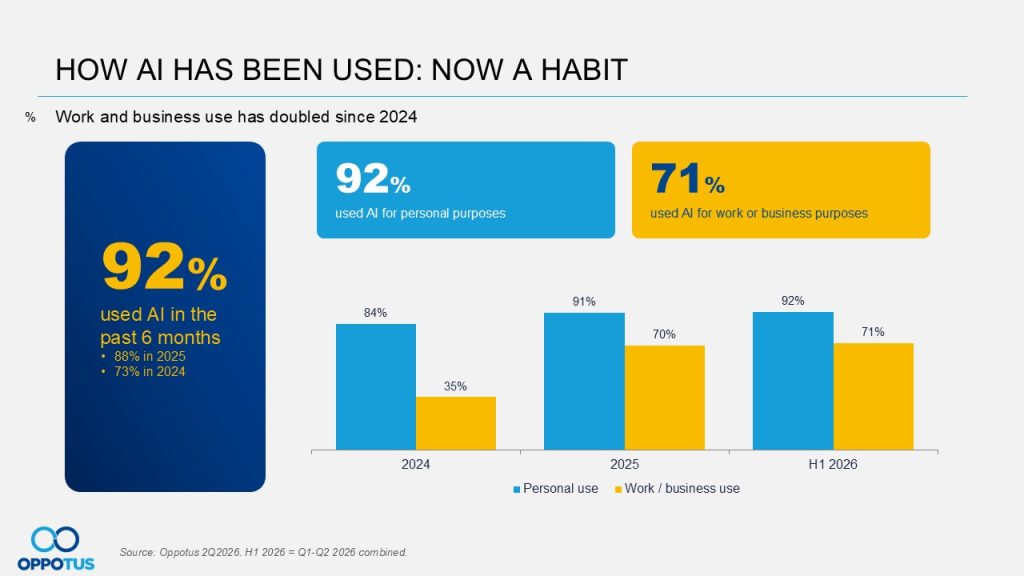
Zooming in on how AI has been used for personal and work/business purposes, there is 26% increment of users who used AI in the past 6 months from 2024 to H1 2026. In H1 2026, 92% of respondents had used AI in the past six months, up from 88% in 2025 and 73% in 2024, an increase of 19 percentage points since 2024. Personal use has reached near-saturation at 92%, which has been steady since the data collection, as it has averaged 89% within these 3 years.
Meanwhile, work/business use has doubled from 35% in 2024 to 71%. Most of that increase took place between 2024 and 2025 (70% in 2025), and the figure has held steady since, suggesting that AI at work has moved from experimentation to a more settled footing.
Why do Malaysians use AI?
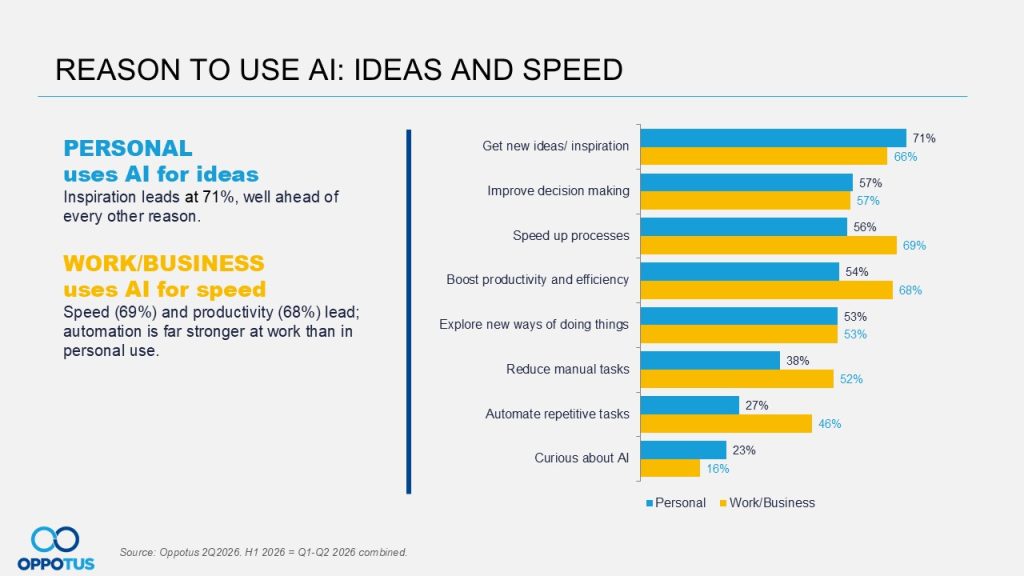
A deeper dive into why Malaysians use AI shows that motivations differ by context. For personal use, ideas lead the way: 71% use AI to get new ideas or inspiration, well ahead of improving decision-making (57%) and speeding up processes (56%). At work, the emphasis shifts towards efficiency, with speeding up processes (69%) and boosting productivity (68%) topping the list, closely followed by inspiration (66%). The gap is most visible in automation: 46% of work users use AI to automate repetitive tasks, compared with 27% for personal use, while 52% use it to reduce manual tasks, compared with 38% for personal use. Also notable is that simple curiosity ranks lowest in both contexts (23% for personal use and 16% for work), indicating that Malaysians are largely using AI with a purpose rather than just to try it out.
Are Malaysian users satisfied with AI at work?
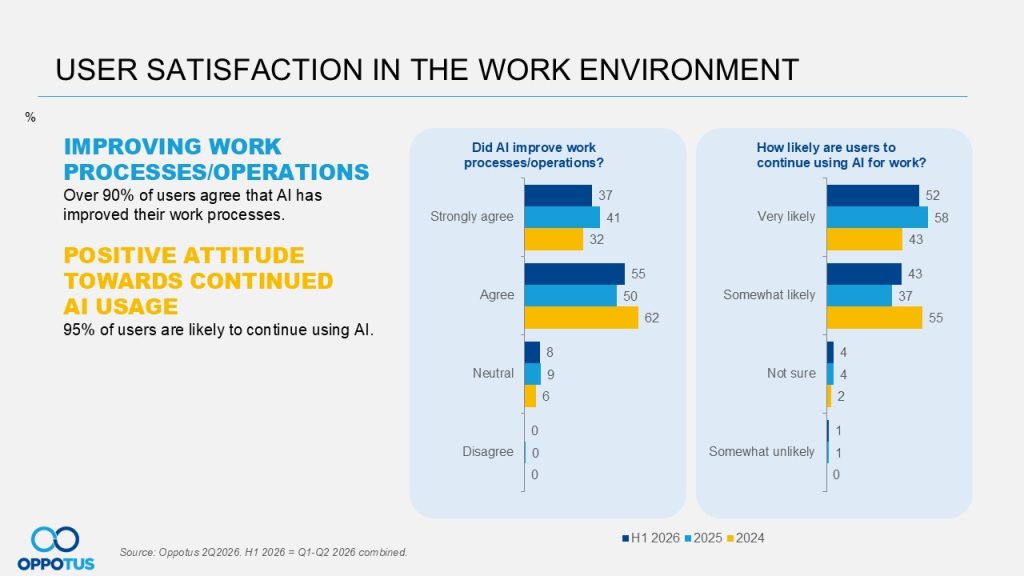
Users in the work environment are also satisfied with the results of AI usage. Over 90% of work users agree that AI has improved their work processes, with 37% strongly agreeing – up from 32% in 2024. Intent to continue is even stronger at 95%, and the share who are “very likely” to keep using AI for work has risen from 43% in 2024 to 52%, though this remains below the 58% seen in 2025. Only 4% are unsure, and just 1% say they are somewhat unlikely to continue.
Who is driving AI adoption at work?
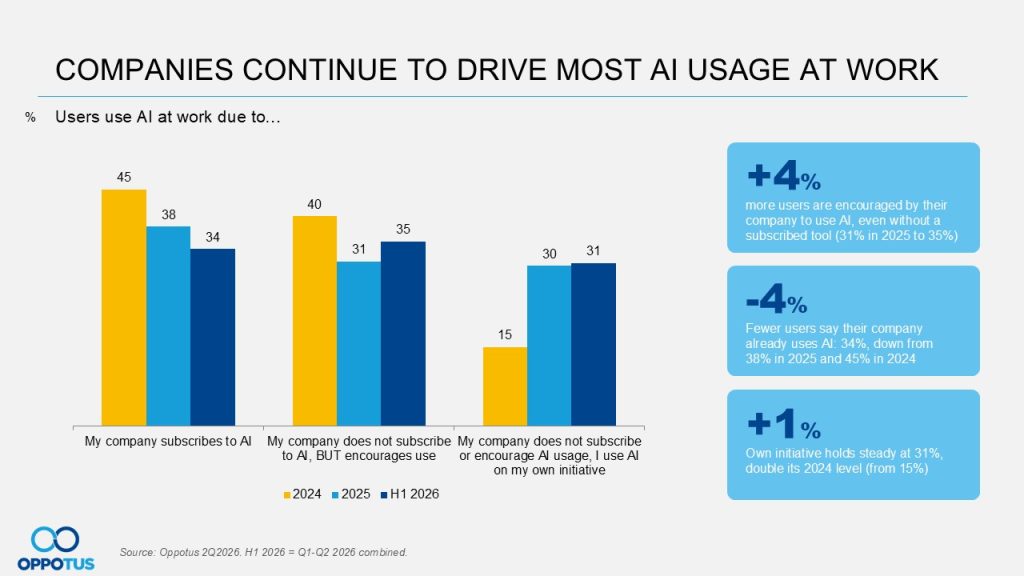
Companies continue to drive most AI usage at work, accounting for a combined 69% of users in H1 2026, but the source of adoption is shifting. The share of users whose company subscribes to AI peaked at 45% in 2024 and has fallen steadily to 38% in 2025 and 34% in H1 2026. By contrast, the share of those whose company does not subscribe but encourages AI use rose from 31% in 2025 to 35% in H1 2026.
Meanwhile, those using AI entirely on their own initiative have doubled from 15% in 2024 to 31%. Put simply, a growing number of employees are not waiting for their employers to provide AI tools, which presents organisations with both an opportunity and a reason to put clear guidance and approved tools in place.
What is the outlook for AI in Malaysia?
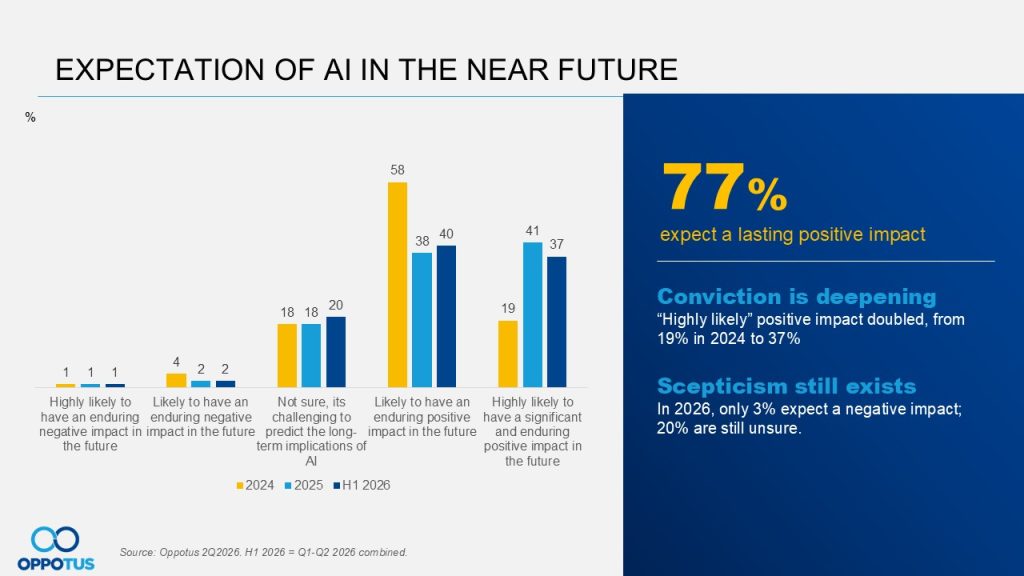
Finally, the outlook for AI in the near future remains optimistic. Overall, 77% of respondents expect AI to have a lasting positive impact, with 37% saying this is “highly likely” and 40% saying “likely”. While the overall share is in line with 2024 (77%) and 2025 (79%), conviction has strengthened: the “highly likely” group has nearly doubled from 19% in 2024, although it has eased from its 2025 peak of 41%. Scepticism remains minimal, with only 3% expecting a negative impact, though one in five (20%) are still unsure about the long-term implications of AI, up slightly from 18% in 2025.
Taken together, the data shows that AI in Malaysia has moved decisively from awareness to habit. Awareness is near-universal: four in five are familiar with AI, nine in ten have used it in the past six months, and chatbots have become the everyday entry point. At work, usage has doubled since 2024; users are largely satisfied and intend to carry on, and their outlook for the future is positive.
Yet the picture is far from static. As company-led adoption gives way to more employee-led adoption, and as general-purpose chatbots take on a growing share of everyday tasks, how will organisations and AI providers respond to users who are increasingly taking the lead themselves? If you would like to dive deeper into the data on AI in Malaysia, feel free to contact us at theteam@oppotus.com.